The first sign that something was wrong with our rental car was easy to explain away.
We had woken up to a cool Michigan morning, and one of the tires was showing low pressure. Coming from Texas, where the weather had not yet received the memo about fall, we assumed the cooler temperature was probably responsible. We headed to a gas station by our hotel, found an air pump and added some air, expecting to get back on the road toward Mackinac.
Instead, the tire pressure started dropping faster.
A customer at the gas station noticed what was happening and told us there was a Discount Tire just around the corner. We arrived well before the shop opened, so we waited in the parking lot, debating whether to contact the rental company instead. We assumed there was probably a nail in the tire and that we could get it patched and be on our way.
Once the shop opened, a technician took over and moved quickly. He diagnosed the real problem almost immediately, discovering that the inside of the tire was worn all the way down to the base layer, with similar wear beginning on another tire. He then worked directly with the rental company, handled the repair, and had us back on the road in less than an hour. What could have become a major disruption to the day was handled with remarkable efficiency.
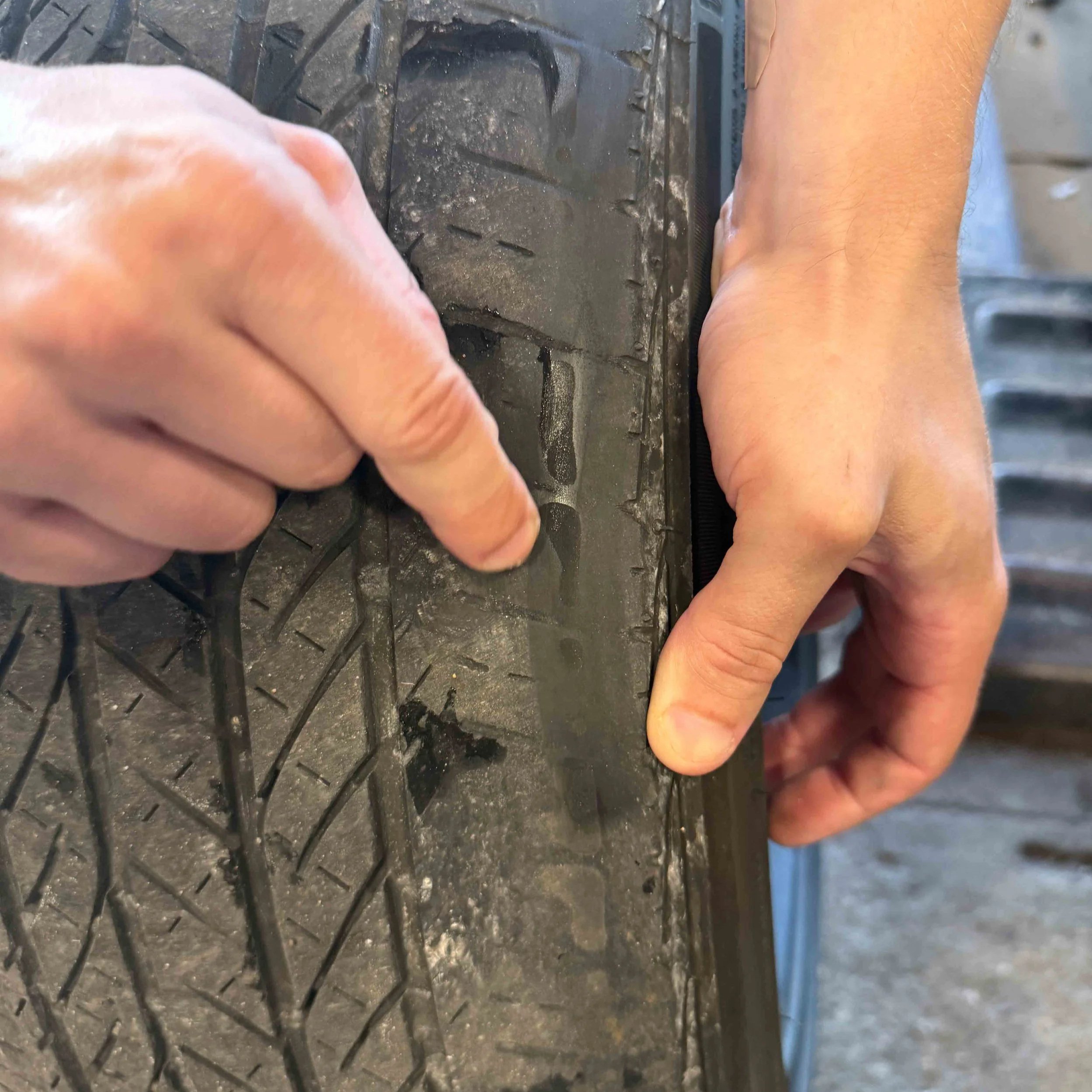
What started as a low-pressure warning on a cool Michigan morning turned out to be significant interior tire wear. A nearby Discount Tire had us back on the road in less than an hour.
It was not part of the itinerary, but it turned out to be a pretty good case study for the book I had brought along.
Writing another post about a favorite book had been sitting on my to-do list for a while, and I wanted to do something similar to an earlier piece I wrote about The Power of Moments. I’ve found that traveling with an idea in mind changes what I notice. The trip still unfolds however it is going to unfold, but certain details start jumping out because I am paying closer attention.
This time, the lens was Will Guidara’s Unreasonable Hospitality and its accompanying Field Guide. Guidara writes about hospitality through the world of restaurants, but the larger idea is much broader: how we create experiences for other people, how we make them feel cared for and what happens when we pay attention beyond the basic transaction.
Before we left, I even used ChatGPT to make my own mini field guide to tuck into the book. It wasn’t complicated, but it gave me a few things to watch for: What did someone notice? What friction did they remove? What did they do that they didn’t technically have to do?
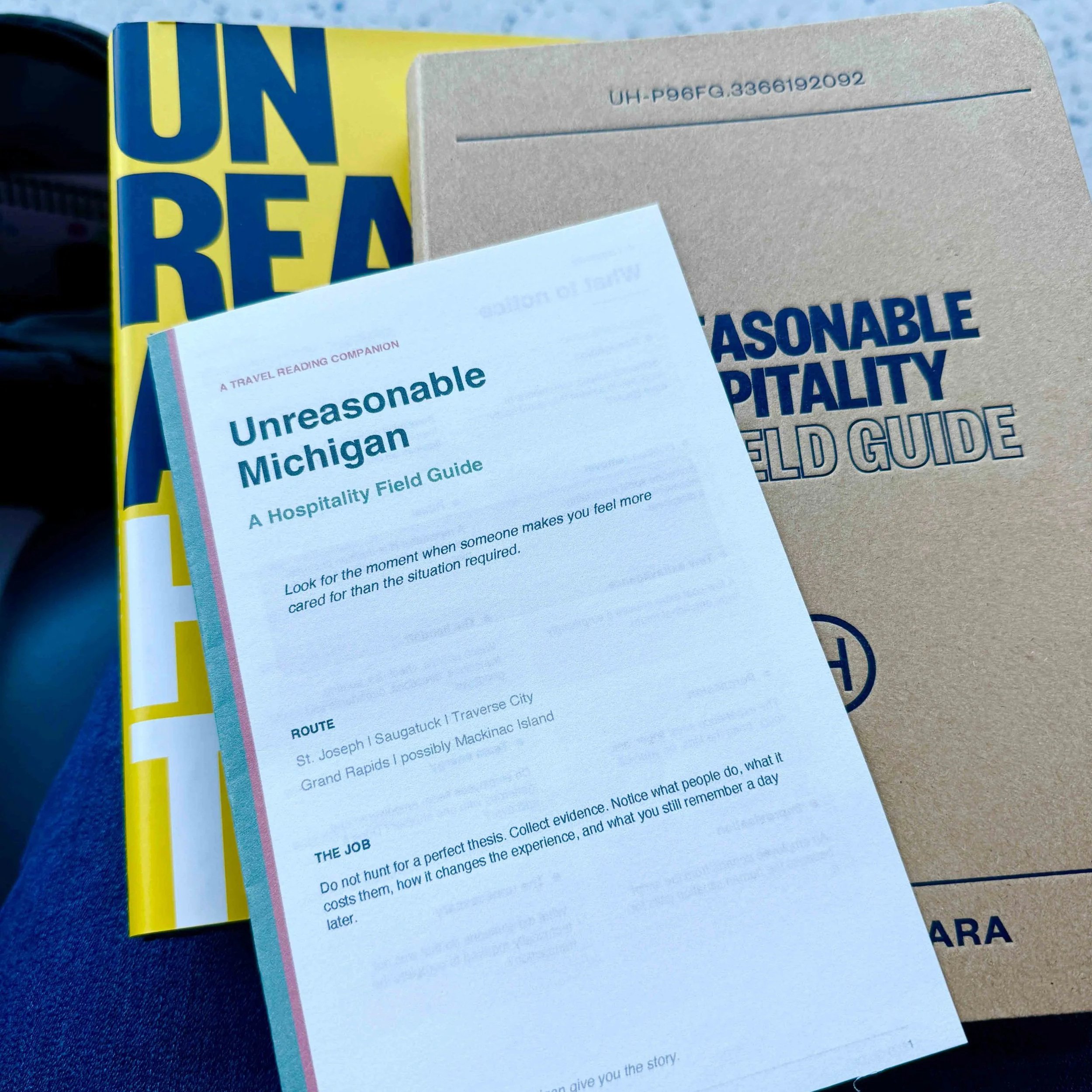
Before the trip, I used ChatGPT to create a mini field guide to tuck inside Guidara’s own: Read. Notice. Jot. Let Michigan give you the story.
The instruction on the front was simple: Read. Notice. Jot. Let Michigan give you the story.
Michigan did.
Planning enough to leave white space
I am a project manager, which means planning is more or less an occupational hazard. I like knowing ALL the details: where we are going, how long it will take to get there, what needs to be booked ahead of time, and whether I have accidentally created a vacation itinerary that requires teleportation.
For this trip, I used ChatGPT to compare routes, estimate drive times, and make sure our plans for St. Joseph, Saugatuck, Traverse City, Mackinac Island and Grand Rapids were realistic.
For work, I live by detailed timelines and project plans. On vacation, I prefer the exact itinerary to remain a little more organic. I want enough structure to know we are headed in the right direction, while leaving room for someone we meet to suggest something better.
That happened throughout Michigan.
A friend suggested we visit Holland. A shop owner in Saugatuck encouraged us to try whitefish dip near Mackinac. Family members and a former colleague supplied other ideas for things to check out along the way.
We also met a couple traveling the Great Loop by boat who talked about how unexpectedly blue and clear the Michigan water had been and told us we should make time for Leland. It was a hidden gem, and conveniently located near Sleeping Bear Dunes where we’d planned to visit that day.
The trip around the trip
I had also been thinking more about the mechanics of travel because I had recently listened to Dan Heath’s air-travel series on his What It’s Like to Be... podcast.
I love podcasts, and I have a habit of sending episodes to people when I hear something that makes me think of them or something they are working on. At this point, it has probably become a running joke among some of my coworkers that if they mention a topic around me, there is a decent chance I’ll end up sharing a podcast link with them.
I know this can be a lot. But it is genuinely my way of trying to be helpful. If I come across an idea, story or perspective that seems useful, my instinct is to pass it along. In some ways, that same instinct showed up throughout this trip. People kept sharing restaurants, towns, foods and little pieces of local knowledge with us because they thought we might enjoy them.
One episode in Heath’s series features Christina Cassotis, CEO of Pittsburgh International Airport, talking about everything required to make an airport work, from route planning and opening a major new terminal to something much less operational: the emotional reunions that happen there.
What interested me about the conversation was how much attention goes into an environment most of us experience primarily as something to just get through.
Airports have to move enormous numbers of people, bags, employees and planes through complicated systems, but they are also places where families reunite, people leave home, someone starts a long-awaited vacation or a traveler simply wants to find the shuttle bus without wandering around a parking structure carrying a suitcase.
Once I started thinking about the airport as part of the experience rather than the hallway leading to the experience, I noticed more of those details.
We flew American Airlines out of DFW, and although our departure was delayed by a few minutes, the plane had quite a few empty seats, and boarding went quickly enough that we still arrived on time. On the way home, Grand Rapids airport was small and easy to navigate, which was especially welcome at the end of a full week of traveling.
Even our parking choice is influenced by experience. We almost always use The Parking Spot, and one of the reasons is embarrassingly simple: the yellow buses covered with black spots are easy to recognize when you walk out of an airport after a long flight. Branding gets discussed in much grander terms, but sometimes branding is useful because you can spot your ride from across a busy terminal.
That idea surfaced again when we came home. Terminal C at DFW was under construction, and we needed to get over to the courtesy-van area. A shuttle driver gave us a ride even though we were ultimately headed to a competing parking service.
He did not have to do that. He simply helped because we were standing there trying to figure out where to go, which was the kind of small interaction I was noticing more because I had Unreasonable Hospitality in the back of my mind.
The little things
Once I started looking for those moments, they appeared everywhere.
We had lunch at The Old Goat, where the food was delicious, the service was excellent and my iced tea arrived in a tiki glass, which was a cute and quirky detail, and made the whole thing more fun. Our server also gave us ideas for things to see later in the trip, extending the experience beyond the meal itself.
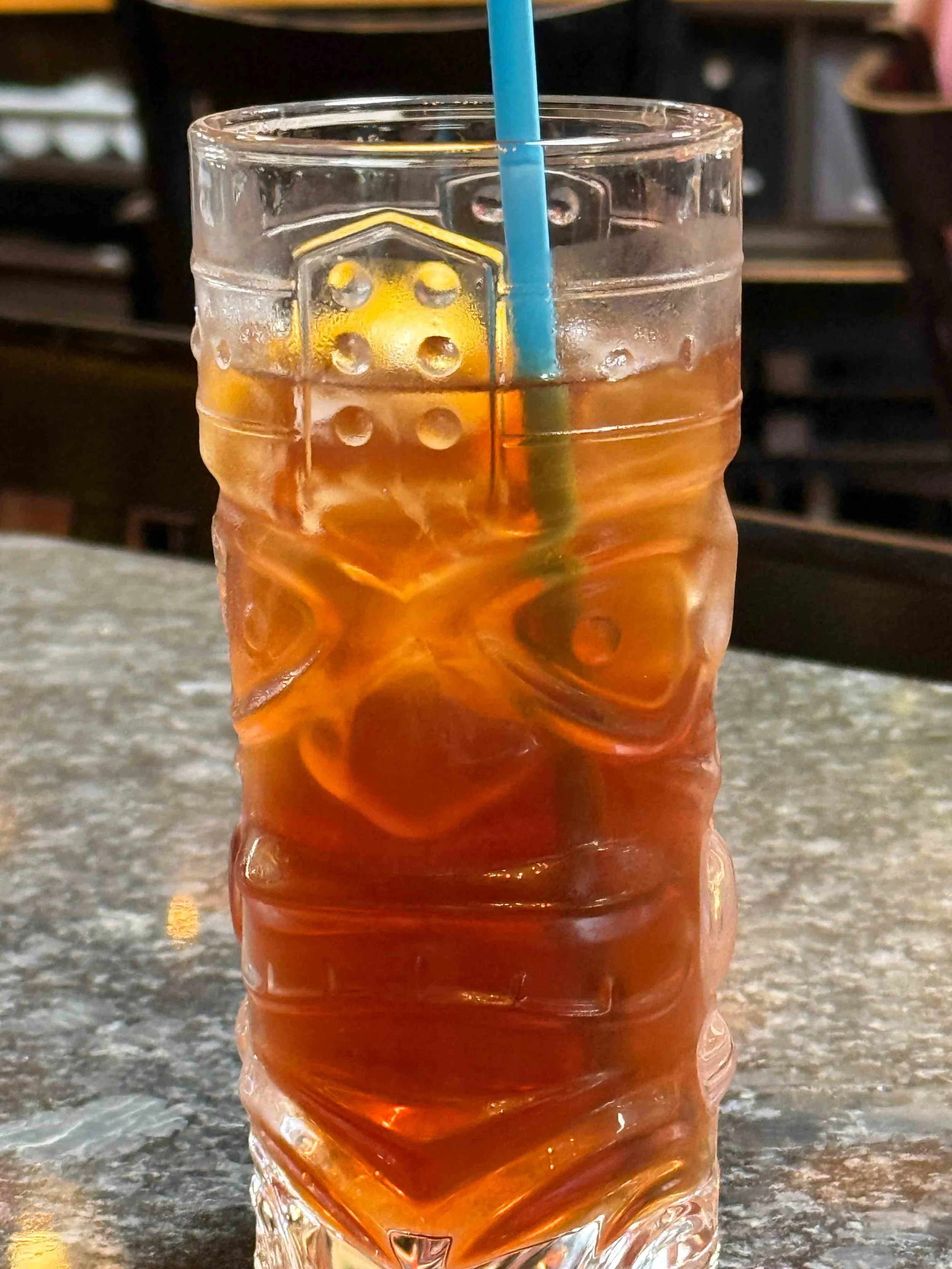
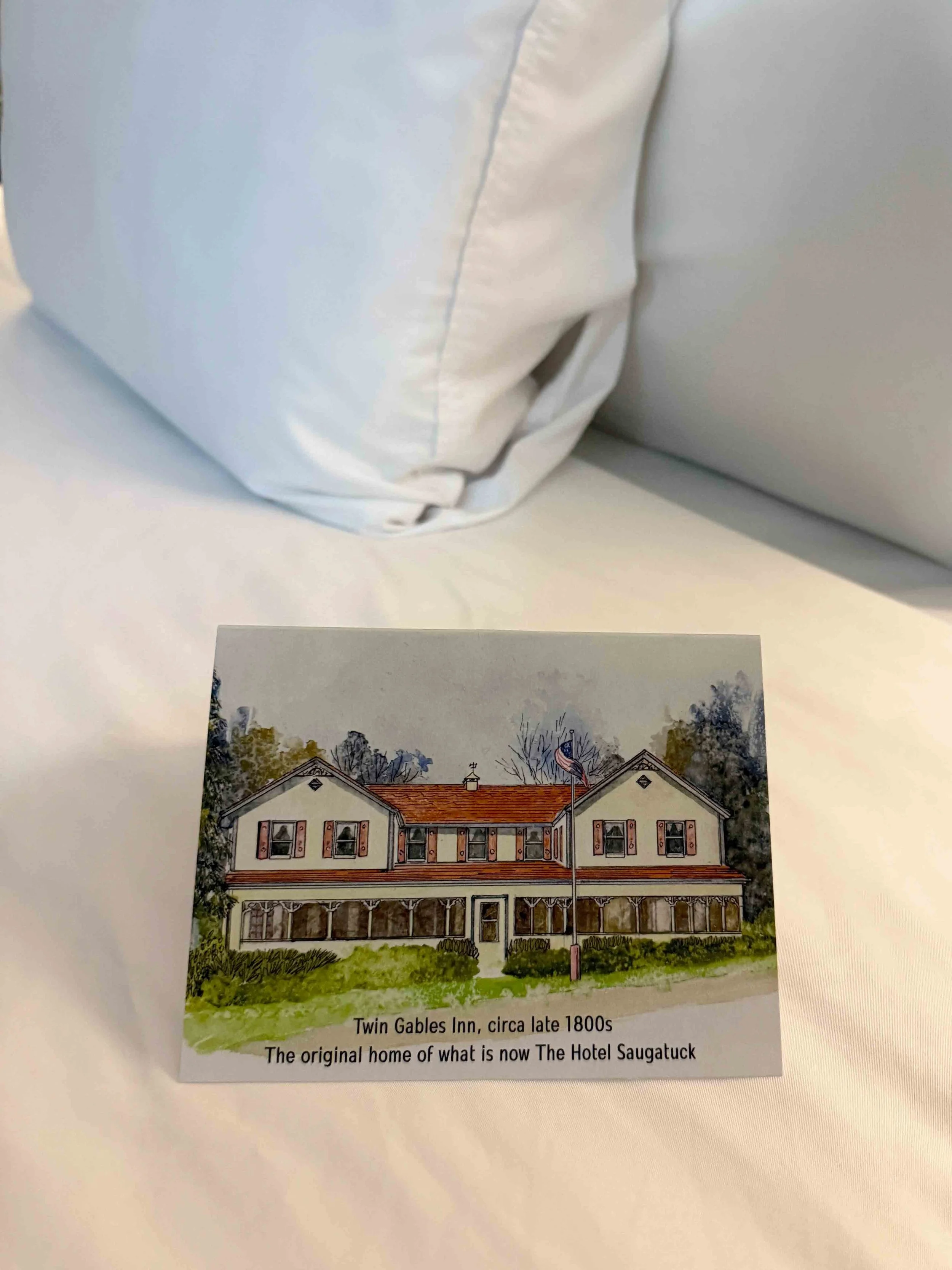
Hospitality showed up in small ways: an iced tea served in a tiki glass at The Old Goat and a handwritten welcome waiting at The Hotel Saugatuck.
At a produce market, both a clerk and another customer helped us find the perfect cantaloupe. At a bookstore, I asked about an older title and the woman working there knew exactly where a copy was tucked away on the shelf.
One B&B welcomed us with a handwritten card and homemade chocolate chip cookies, a simple gesture that immediately made arriving feel more personal.
Other experiences stood out because they required almost no thought from us at all. Hotel check-ins and checkouts were consistently smooth, and at one property our room key also let us exit the parking garage. We tend to return to familiar hotel brands partly because that consistency reduces the number of small things we have to figure out while traveling.
The ferry to Mackinac had the same quality. Moving tourists, bicycles and luggage back and forth all day could easily feel chaotic, yet it ran with efficiency and felt effortless.
Reading Unreasonable Hospitality made me appreciate both sides of the experience: the thoughtful extra and the well-designed process. Sometimes the thing that makes an experience better is a homemade cookie, while other times it is simply having considered the customer well enough that there is no unnecessary problem to solve.
A different kind of hospitality
Some of the most meaningful parts of the week had nothing to do with tourism.
We spent time with my aunt, uncle and cousins in St. Joseph, and during our visit I learned much more about my uncle’s professional background. His career included product development, technical writing and documentation connected to work ranging from telescopes at Goddard and support for the Gemini program to early machine-learning applications designed to predict automobile accidents and educational robotics such as Heath’s HERO 1.
Given how much time I now spend thinking and writing about AI, technology and human experience, I loved hearing about work that connected so directly to the longer history behind the tools we talk about today.
Generative AI can make our current moment feel brand new, but there are decades of research, engineering, documentation, experimentation and problem-solving underneath the systems we now casually open in a browser.
That conversation was one of my favorite surprises of the trip because I never could have planned for it.
The image that stayed with me most from our family visit was even simpler.
When it was time for us to leave, my aunt and uncle stood by the door as we pulled out of the driveway.
I can still picture them there.
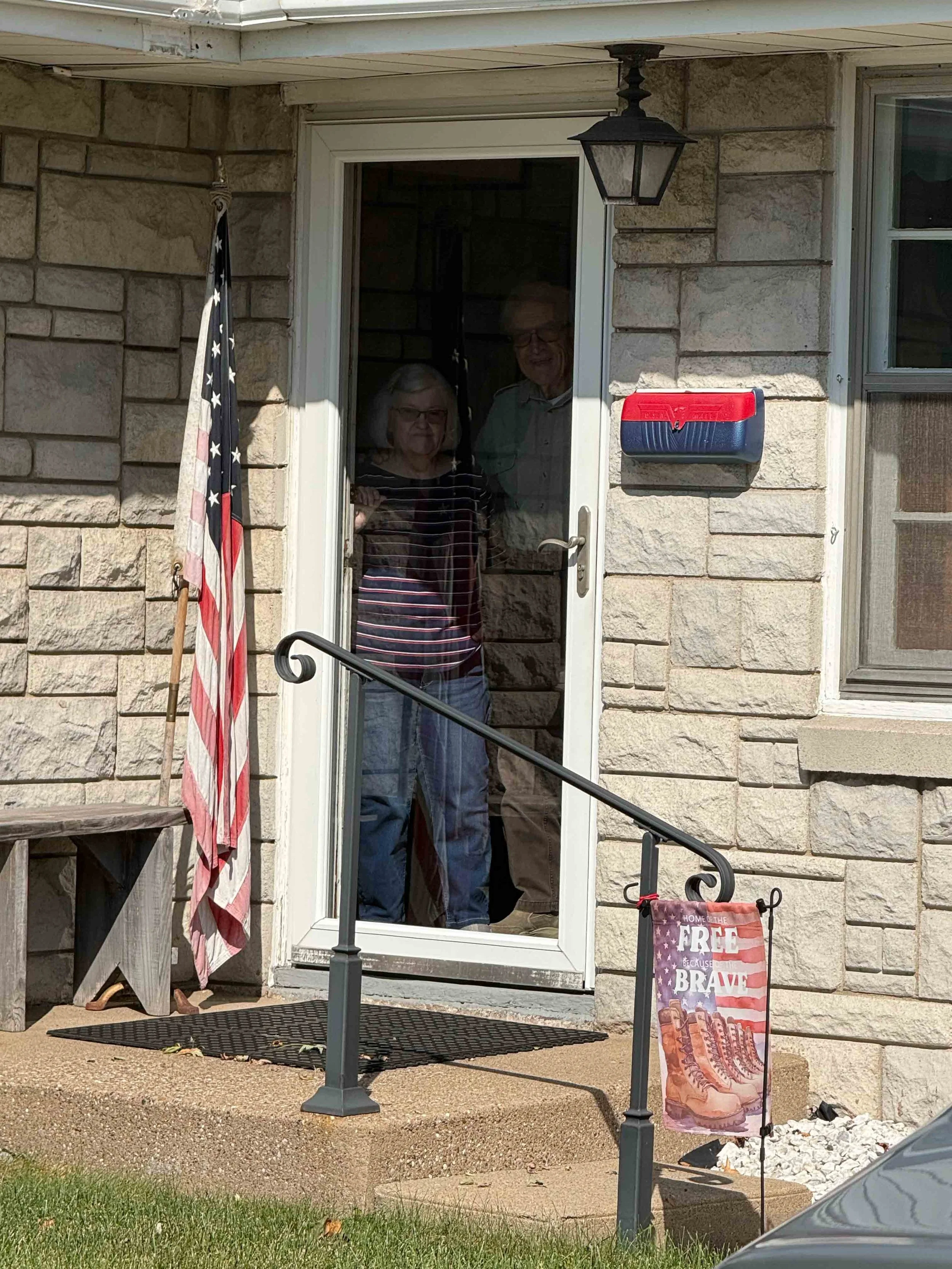
Some of the most meaningful hospitality of the trip had nothing to do with customer service.
After spending the trip thinking about hospitality in terms of customer experiences, service design, and thoughtful gestures, that moment stripped the idea down to something much more basic. They had welcomed us into their home, spent time with us and stood there watching until we drove away.
It made me feel seen and cared for, which may be as good a definition of hospitality as any.
When the experience breaks down
The tire incident provided the clearest example of what happens when the experience goes the other direction.
The worn tire should have been caught before the rental car ever reached us, especially since a second tire showed similar interior wear. I later let the rental company know that they might want to check the alignment as well.
The company had also provided a text thread specifically for problems during the rental. I used it when we realized how quickly the tire was losing pressure, but we did not receive a response until much later that evening.
There is an obvious opportunity for technology to strengthen that experience. A support system could recognize words related to a rapidly deflating tire, brake failure, an accident or another potential safety issue and escalate those messages instead of treating them like ordinary customer-service questions. AI might make that kind of classification more sophisticated, but even a thoughtful system of trigger words and escalation rules could make a meaningful difference.
Of course, the stronger experience would have started with catching the worn tires before we drove away.
That distinction matters because there is a tendency right now to look at every problem and ask how AI might solve it. Sometimes AI may be the right answer, while other situations need a better process, better quality control, or a more useful connection between existing systems.
Technology should strengthen the experience.
One last handoff
We got one final example after landing back in Texas.
At The Parking Spot, I scanned the QR code for our automated checkout and was told that I had parked in the wrong area, which meant I couldn’t receive the uncovered rate I had reserved, even though that was exactly where I had parked.
The process still has some manual pieces. You are directed toward an area rather than assigned a specific space, and the shuttle driver gives you a card showing where you left the car. Somewhere along the way, that information did not make it into the automated checkout experience.
Luckily, there was a person in the booth. She was busy helping incoming vehicles and wasn’t technically handling exits, but once she understood what was happening, she stepped in, corrected the rate and made sure we were charged accurately.
There are undoubtedly ways technology could make that process more seamless, but I was glad there was still a human in the loop who could recognize that the system was wrong and fix it. A potentially frustrating end to the trip became a minor inconvenience instead.
The best technology-enabled experiences still need to account for the fact that reality does not always follow the expected path.
What I noticed because I was looking
By the time we returned from Pure Michigan to the Pure Misery of Texas, where we were hit with the kind of heat that made those cool lake breezes feel very far away, I realized the book and my little field guide had done exactly what I hoped they would do.
They made me notice.
I noticed the handwritten card and homemade cookies, the tiki glass, the bookstore employee who knew exactly where to look and the shop owner who wanted to make sure we tried the whitefish dip.
I noticed how often people shared something simply because they thought it might make our experience better, whether it was a coworker, family member, shop owner, fellow traveler or stranger at a gas station. Perhaps that is also why I keep sending everyone podcast episodes.
Most of all, I noticed that the best parts of the trip were rarely the ones I could have planned in advance.
I will continue using ChatGPT for my travel planning: to compare routes, check distances, and make sure future vacations are logistically possible (because I remain a project manager and apparently there are limits to my commitment to spontaneity.)
But I also want to keep leaving some white space in the itinerary.
The tools can help me get oriented, while good systems can make travel considerably easier. What stays with me most are the conversations, recommendations, gestures, and unexpected moments that appear once there is enough room for the experience to unfold.
Looking back, I remember where we went, but I remember even more clearly how people made us feel while we were there.