Our team has a bi-weekly learning series called Tech Talk, where we cover everything from AI to digital development and marketing trends. Recently, I presented on Anthropic’s Hard Questions campaign.
I stumbled across Anthropic’s post in my LinkedIn feed. The opening frame showed a house on fire, which immediately caught my attention. I clicked, and then did what most marketers do and followed the trail to see what campaign landing page was paying off the click.
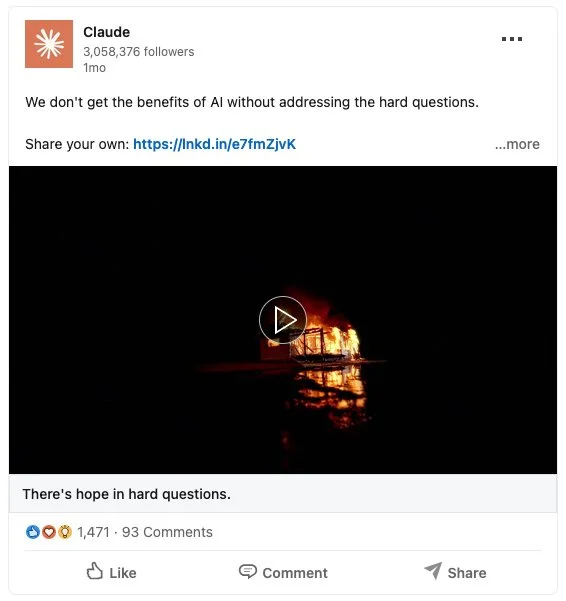
The post led to Claude’s Hard Questions landing page, built around the idea that there is “hope in hard questions.” From there, Anthropic points visitors toward its Path to Hope, where the campaign expands into research, policy, commitments and an interactive Keep Thinking section addressing questions such as “How does AI work?”, “Who should govern AI?” and “What is AI’s impact on society?”
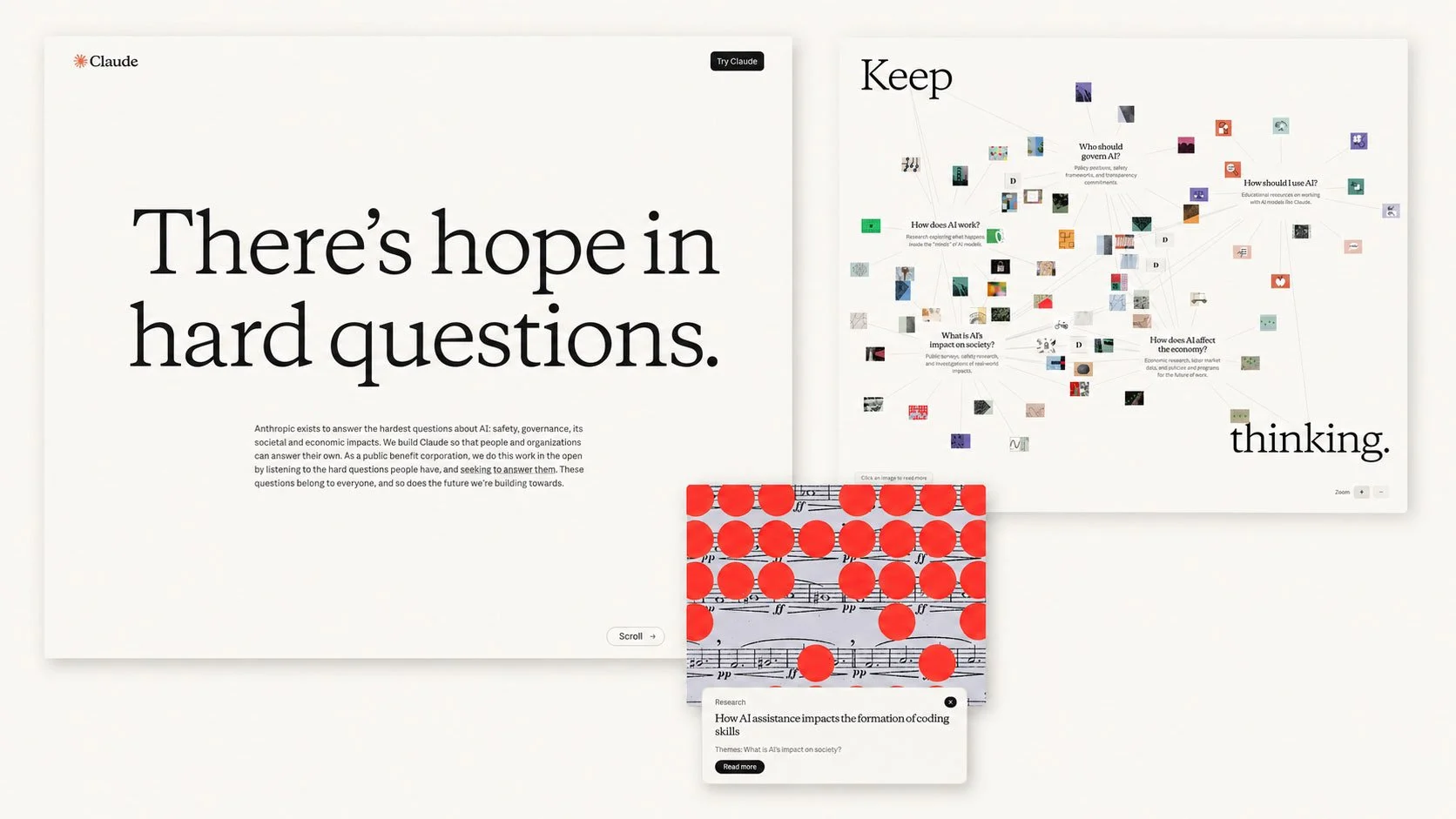
The social post leads into a much larger question-led content experience.
The campaign was created with Mother London, and according to Little Black Book, it draws on conversations and research involving more than 120,000 people.
The campaign has gotten mixed reactions, which is not surprising. AI is such a polarizing topic. Still, I appreciate that Anthropic is addressing what it knows is the elephant in the room. Most people are not enthusiastic about AI. There is some curiosity, but also anxiety, skepticism, fatigue, and a lot of unanswered questions. So it is already interesting to see how the frontier labs, including Anthropic, OpenAI, Google, and Meta, market themselves in this environment.
What immediately came to mind, though, was something more strategic.
The question is the content engine
The genius of the Hard Questions campaign is that it is essentially an unlimited marketing content engine.
So many pieces of content can come out of it. Website content, social posts, case studies, and industry reports. A question like “What does AI mean for my job?” does not produce one piece of content. It can produce dozens. It can branch by industry, by role, by age group, by level of technical fluency, and by degree of optimism or concern.
That immediately made me think of Marcus Sheridan’s They Ask You Answer.
Sheridan’s idea is straightforward: pay attention to what customers really want to know and answer those questions openly, including the ones businesses tend to avoid.
He calls these the “Big 5”: price, problems, best in class, reviews, and comparisons.
Anthropic has applied a version of that idea to much bigger questions.
However, asking is easier than answering so it will be interesting to see whether it keeps answering them. Anthropic gets to take the anxiety surrounding AI and turn it into branded content. Every fear becomes another potential ad, article or case study. Even the creative execution is highly repeatable. The original video uses striking photography, recorded voices, music and relatively simple transitions. The burning house got my attention, but that same format can be extended across dozens of questions without producing a completely new campaign each time.
That is smart marketing, but whether it builds trust depends on what follows.
If Anthropic publishes research, acknowledges uncomfortable findings, changes policies or products, and comes back later to show what happened, the campaign becomes more meaningful. If the questions mainly fuel another stream of branded content, the exercise starts to look more like trust theater.
That’s an important distinction as it relates to Sheridan’s philosophy. They Ask You Answer is not simply identifying the questions people have. You actually have to answer them.
They ask you answer, updated for AI
That connection became stronger when I found a recent Qualified Remodeler podcast with Sheridan.
The conversation covers how AI is changing customer research, but many of his well-established ideas remain intact. Buyers still care about trust and pricing. And businesses still need to make their expertise and credibility clear.
However, the way a customer finds information has changed.
A customer may no longer begin with a list of Google results and visit ten websites. They might instead research via Google’s AI Mode, ChatGPT or Claude.
This reminded me of a recent personal example.
Just last week, we had a sewer pipe leak at our house. The repair involved a nine-foot hole, three days of work, and a weekend of being very careful about flushing toilets and running laundry.
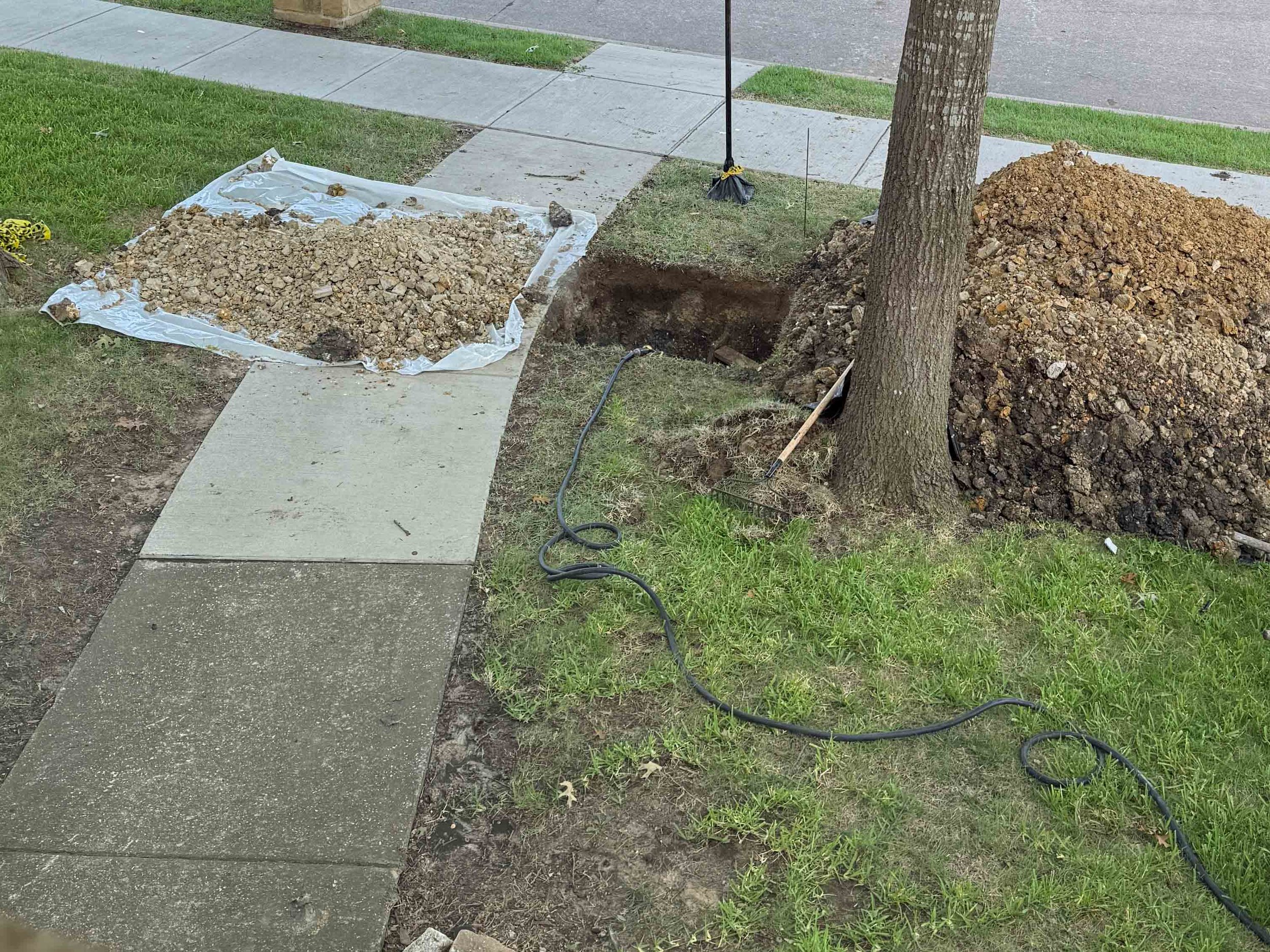
Nine feet down and three days later, we had a working sewer line again.
Fortunately, we already had a plumber we trusted. But if we were starting from scratch, my research would likely involve searching across Google via Gemini, ChatGPT or Claude. With those tools, I would no longer just type “plumber near me.” I would give the AI a more detailed prompt with more information about my issue, my location, and would request information about what others are saying about the contractors.
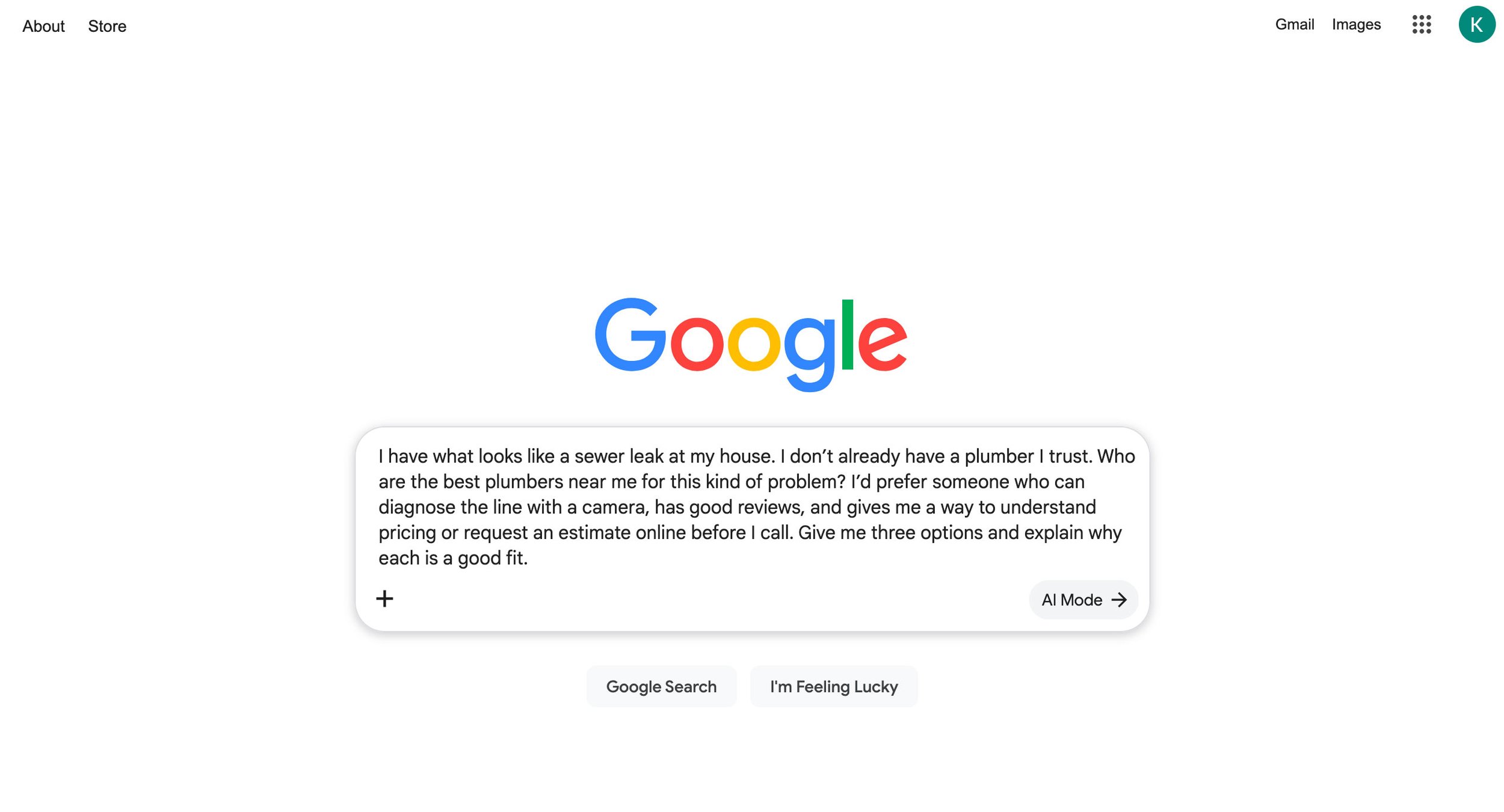
A conversational search gives Google far more context than “plumber near me,” including the specific trust and service signals that matter to me.
That scenario became a useful thought experiment for this post.
When I tested this in Google AI Mode, Milestone Electric, A/C & Plumbing surfaced prominently.
Then I started looking at why.
Give AI something concrete to work with
In the research I did for this post, I found that Milestone is a good example of a company making these differentiators easy for AI systems to verify. Milestone covered all the key attributes customers care about, including expertise, pricing transparency, and trust markers like review volume, licensing, guarantees and years in business.
Even more interesting, Milestone has a separate AI-oriented site containing FAQs, service information, local pages and cost-related content. The site itself states that it is optimized for search engines and AI bots.
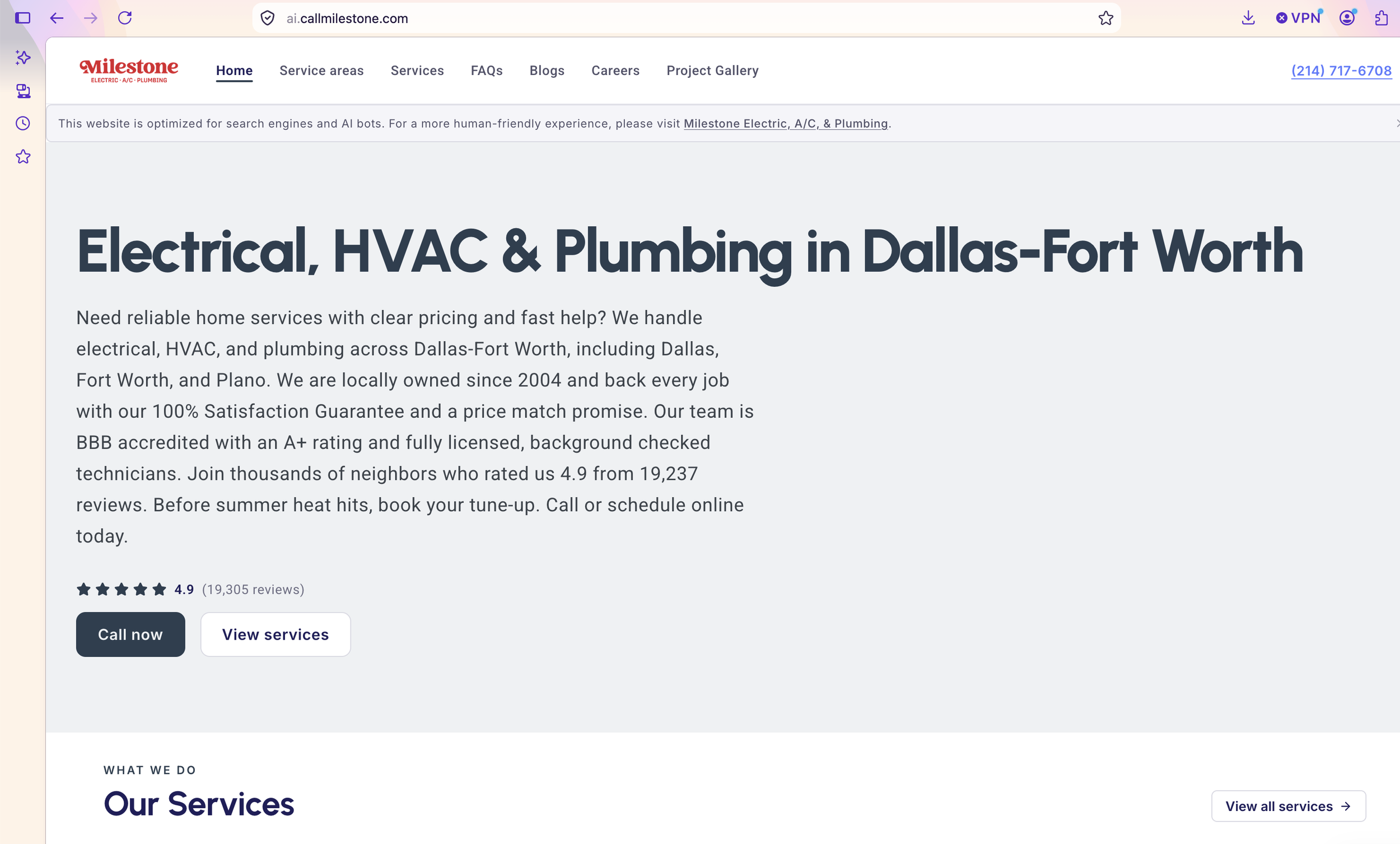
Milestone created a site on a subdomain with structured content intended for AI systems.
That does not necessarily prove that the AI-specific site caused Milestone to appear in my search. Google says there are no special tricks required to appear in its AI search experiences aside from applying the foundational SEO best practices like providing genuinely helpful content.
An AI system trying to answer my question needs evidence.
Does this company work in my area?
Does it handle sewer problems?
Does it use cameras?
Can I book online?
Can I understand the pricing process?
Do other customers appear to trust it?
The easier those answers are to find and verify, the easier it is for an AI system to determine that a company matches what I asked for.
They Ask You Answer is still relevant even in a world with AI.
The audience has changed, but the questions haven’t
Content creators shouldn’t try to game the system. Creating hundreds of pages designed primarily for AI is not necessarily going to work. During my research, I found stale and inconsistent information in some of Milestone’s AI-oriented content. Making information easy for AI to find also makes outdated information easy for AI to find.
The better takeaway is much closer to Sheridan’s original philosophy: answer what people genuinely want to know. Make your expertise clear and mention pricing when you can. Support your claims, be transparent and keep the information accurate.
Anthropic’s Hard Questions campaign made me think about this from the content side. My plumbing experiment made me think about it from the search side.
The questions customers ask can still be the content strategy.
Now those answers may also become the evidence an AI system uses to decide whether to recommend you.