I’ve started writing these articles as a way to explore whatever happens to catch my attention in the AI and marketing space. I never know what I’m going to write about from week to week, but every now and then, an idea comes to me when I least expect it.
That happened recently when I came across a Google Cloud article about agentic commerce. As I skimmed through the article, an example about an AI-powered Scent Advisor, built by Estée Lauder and Jo Malone London, caught my eye.
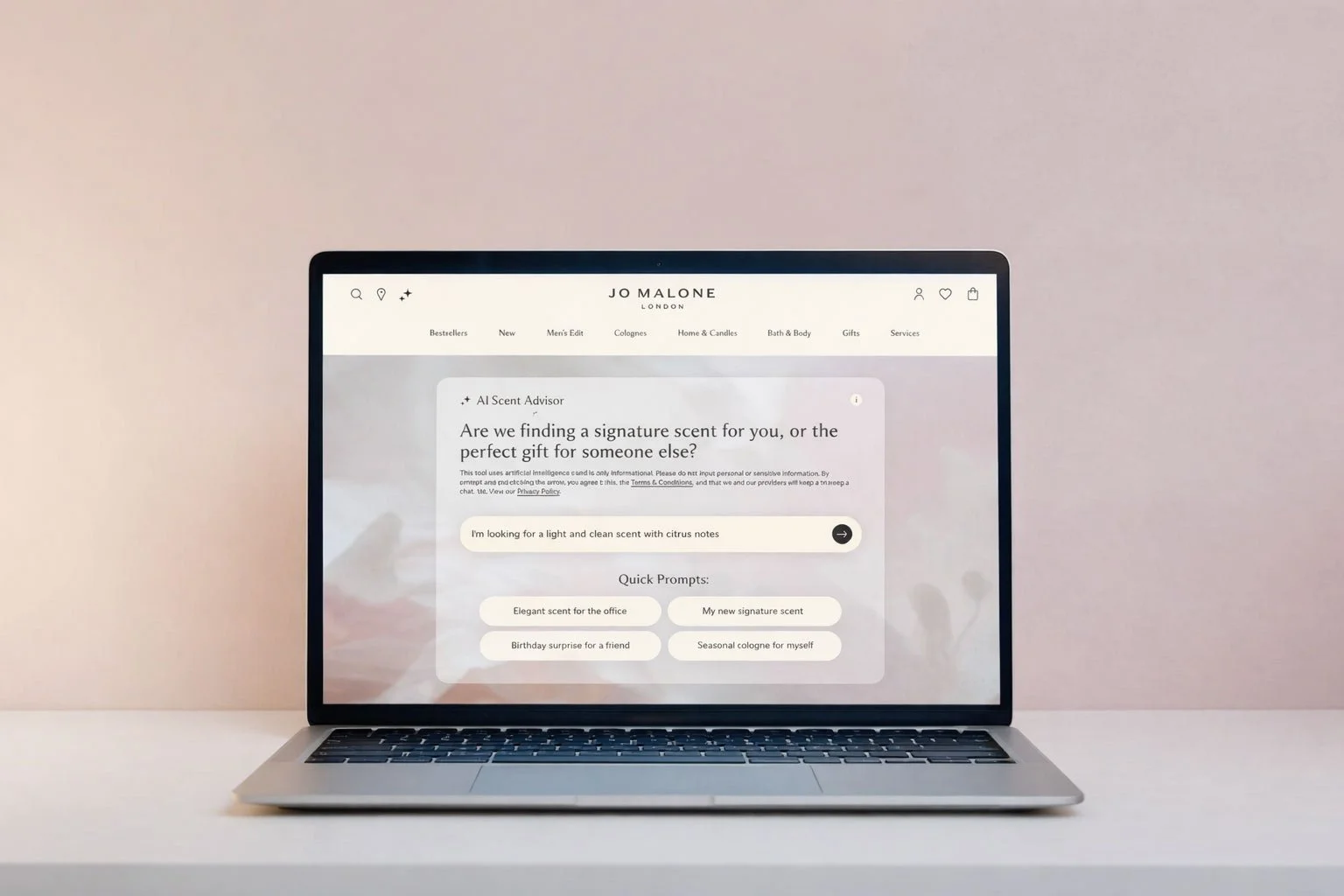
The Jo Malone London AI Scent Advisor walks users through a guided fragrance discovery flow.
If you know me at all, this won’t surprise you. One of my absolute favorite things in the world is fragrance. When I first moved to Texas, I evaluated my first apartment the way most people do: layout, light, location, and price. All of that mattered, of course, but the moment I walked into the model unit, it smelled like fresh-baked cookies. That detail didn’t replace the practical considerations, but it definitely nudged the decision along. It’s an old real estate trick, but I can personally confirm that it works!
I was reminded of this again recently at a favorite local breakfast spot. They always have a candle burning, and the space smells like a freshly baked pecan pie. It’s warm and comforting, and it sets the tone the moment you walk in.

Scent has always intrigued me because it behaves a lot like music in the way that it triggers memory and emotion. The more I learn about AI, the more it feels like everything is being rapidly automated. Some things lend themselves to that more easily than others. Scent is one of the last areas where that seems possible, because it’s highly subjective, context-dependent, and difficult to validate.
Yet it seems AI is making progress in this area too. Once I started researching the topic, I found several interesting examples tackling scent from different directions, from retail to events to smart environments.
AI as a translator for scent
One of the most practical uses of AI in this space shows up when you look at fragrance shopping online. Fragrances can be expensive and people often don’t want to spend a lot of money on something they can’t sample in-person.
Also, people often have a hard time describing fragrances. That’s part of the challenge the AI Scent Advisor is trying to solve.
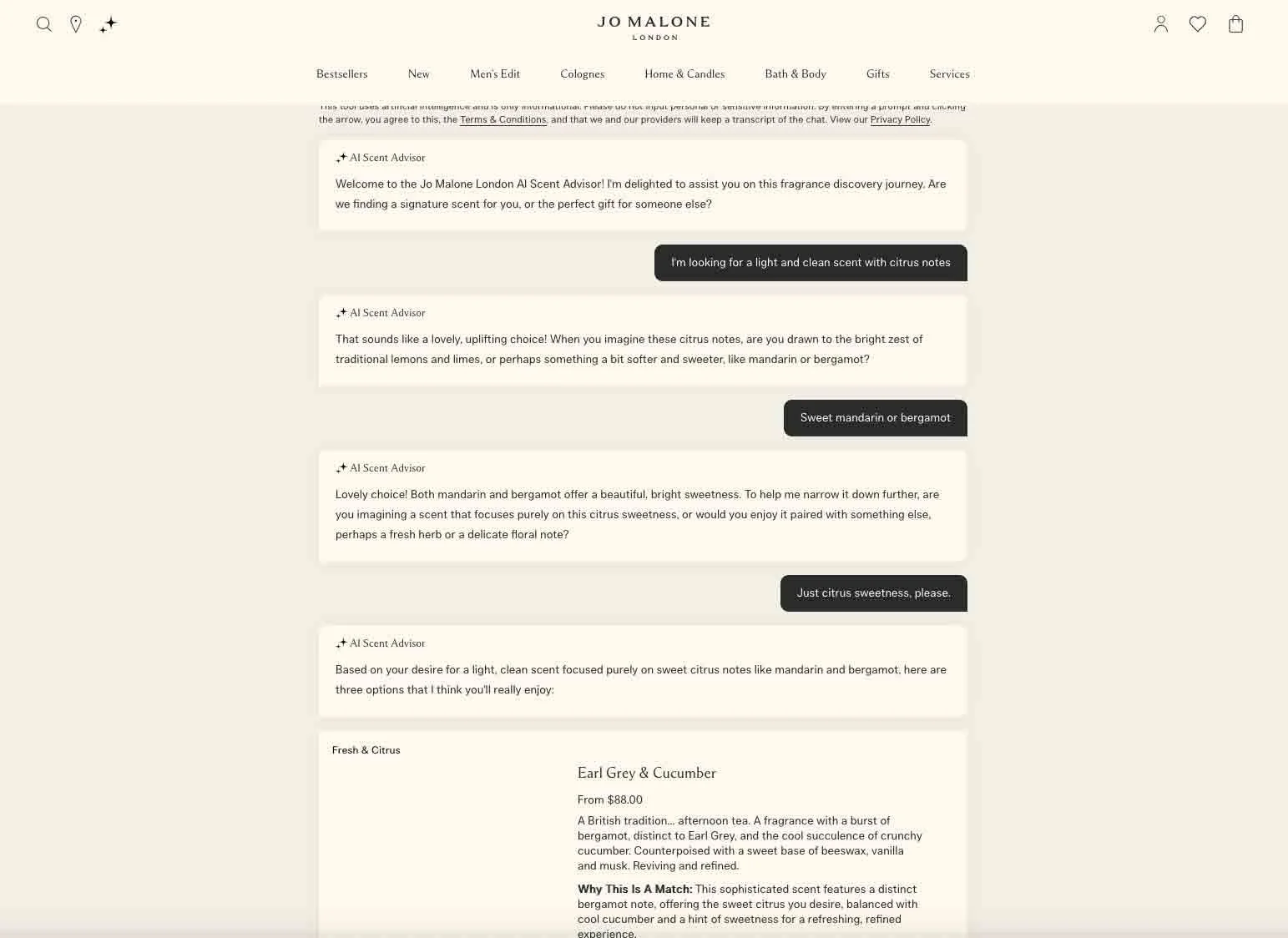
The Jo Malone London AI Scent Advisor translates everyday language into fragrance preferences through a guided conversation.
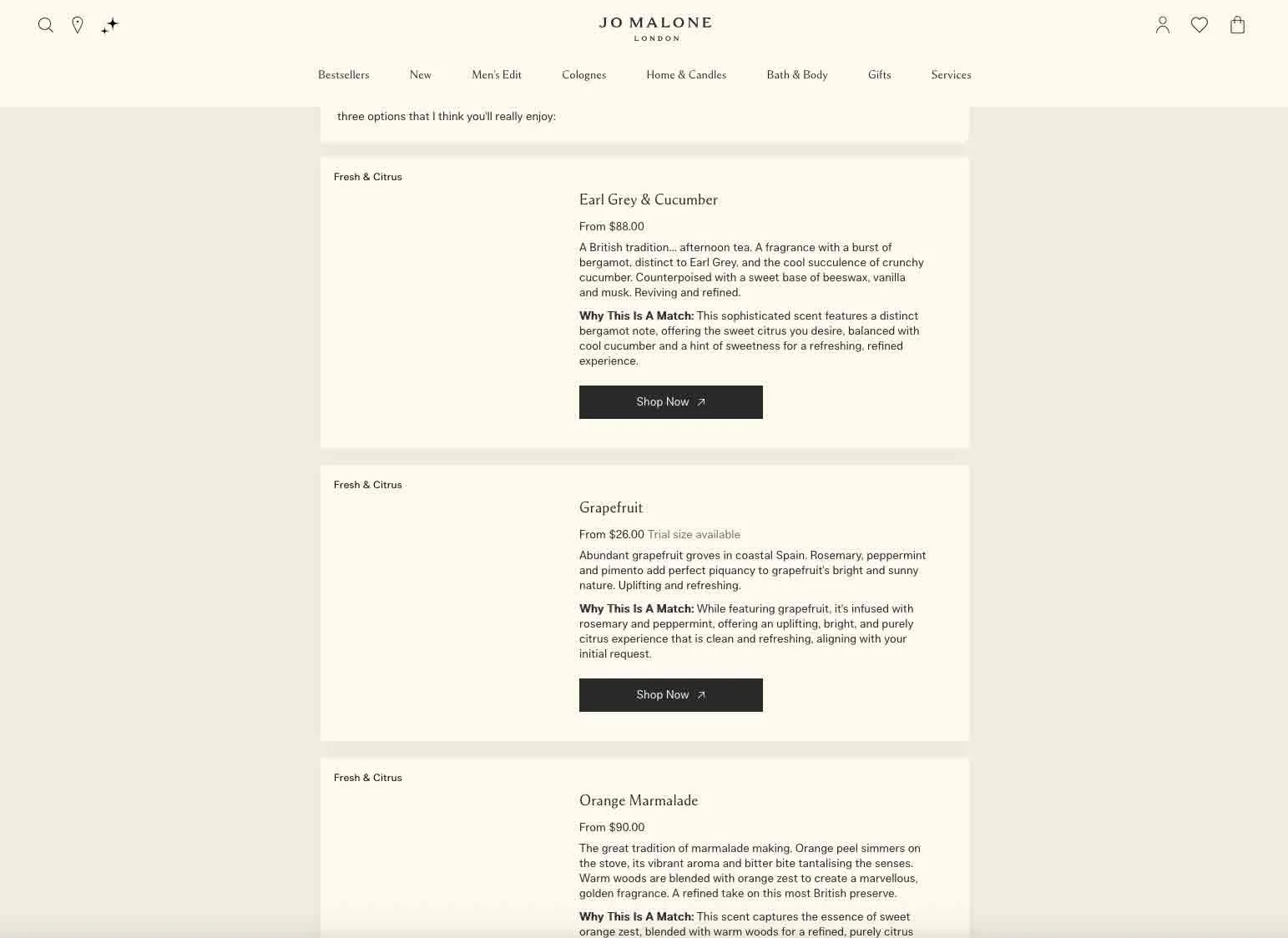
Based on the conversation, the AI Scent Advisor surfaces specific fragrance recommendations and explains why each one is a match.
The Estée Lauder Companies worked with Google Cloud to build a conversational agent that recreates the in-store consultation experience online. It allows customers to describe scents in their own natural language, then maps those descriptions to structured olfactory data.
The model was trained on:
technical scent categories
emotional and sensory descriptions
recordings of real scent stylists using a “tell, explain, describe” approach
It’s been especially impactful for business. As mentioned in this Wall Street Journal article, since launching, shoppers who used the tool made purchases at nearly double the rate of those who didn’t.
Scent as a physical, in-person experience
Scent marketing is fascinating. It’s often a subtle part of an environmental experience. You might not consciously register it, but you’d notice if it were missing. Hotel lobbies are a good example. You walk in, and before you’ve checked in or spoken to anyone, the space already feels calm, clean, and welcoming. Gyms do this too, with scents like eucalyptus or grapefruit to reinforce energy and freshness.
I was interested in learning more about it, and that curiosity led me to a podcast interview with Tiffany Rose Goodyear, the founder of Scentex, on the Durable Entrepreneurs podcast. Her company specializes in scenting events and large physical spaces, including tech conferences.
Tiffany mentions their process starts with a discovery call that considers details like time of day, food, and how the client wants people to feel. Scents are developed and samples are delivered without branding to remove bias. The physical packaging of those samples is treated as part of the experience itself.
What was most interesting was how hands-on the work actually is. Scenting a space isn’t something you set once and walk away from. There are constant variables, including airflow, temperature, humidity, and whatever already exists in the environment. Because of that, teams execute in real time, adjusting as conditions change.
That complexity helps explain why scent is such a difficult thing to automate. The same fragrance can behave very differently depending on where it’s used. Something that feels subtle and pleasant in a large open space might feel heavy in a smaller one, or disappear entirely in another setting. Human judgment is still required at every step, from selection to execution.
You can’t experience scent through a screen (yet). You have to be physically there in the space. That requirement puts scent in a very different category than most experiences we’re trying to digitize or automate.
Sensors and olfactory data at events
The Consumer Electronics Show (CES 2026) was held recently and news coverage coming out of that event talked about the rise of scent-related sensors and analytics. A LinkedIn article by Max Lenderman mentioned companies like JENLiFE are working on “electronic noses” that can detect and classify odor molecules in the air.
Sensors can help confirm air quality, detect unwanted odors, or ensure a signature scent is present at the right intensity. In hospitality settings, this kind of data can feed back into HVAC systems before a guest ever notices something feels off.
AI performs better in these scenarios because the outputs are clearer. Is the air fresh? Is the scent present? AI tends to make progress first where the question is well-defined.
Smart homes and adaptive scent
Scent is also starting to show up as part of the broader smart home conversation. Companies like DeepScent AI (also a CES 2026 mention) are experimenting with systems that generate scent based on inputs like time of day, lighting, music, or user routines.
In this model, which has been trained on over 100,000 fragrance data points, scent becomes another layer of the environment, similar to lighting or sound. The system adapts over time, adjusting blends rather than relying on a single static fragrance to deliver a personalized experience. This approach still depends on physical delivery systems and environmental conditions but is an interesting look at where the tech is heading for smart homes.
Scent, memory, and interpretation
Another example I came across takes a more experimental approach. Researchers at the MIT Media Lab have developed a prototype called the Anemoia Device that turns photographs into custom fragrances. The name comes from the term “anemoia,” which describes nostalgia for a time you’ve never personally experienced.
As someone who loves photography, this immediately caught my attention. The idea of translating an image into scent felt like a natural extension of how photos already work for memory.
The device analyzes a photograph using AI, then lets the user guide the interpretation through a few manual dials. The final scent is blended from a limited library of around 50 fragrance components. According to Cyrus Clarke, who developed the project, the system compresses a layered visual memory into something sensory. Two people can start with the same image and end up with very different results, which is what makes it interesting. In this case, AI is used as a collaborator rather than a decision-maker.
Why scent is still hard to digitize
A good example of why scent is so difficult to automate is something most people are familiar with: the smell of rain.
You know it immediately when it happens (especially after a long dry stretch), but it’s difficult to describe. That scent, often referred to as petrichor, is influenced by soil composition, bacteria, surrounding plants, and even how hard the rain falls.
What’s interesting is that it isn’t the same everywhere. In parts of West Texas, the smell of rain is shaped by a specific native bush that releases oils into the air when it rains. Even though I haven’t experienced that firsthand, it’s intriguing because it highlights how regional and contextual scent really is. Two people can talk about “the smell of rain” and mean slightly different things, based entirely on where they’re from.
That’s the challenge AI runs into with scent. People recognize it instantly, but they struggle to explain it. Even when they can, the same description might point to different experiences for different people. Memory, place, and association all play a role.
AI can help organize data, translate language, and narrow options. But scent still depends on context, environment, and physical presence.
Even as AI continues to make progress here, scent feels like one of the last areas we’ll be able to fully automate. I’m glad some things still require us to be present and human.